I recently attended a leadership seminar at The Holdsworth Center, and upon leaving, I encountered a profound quote from Charles Butt that succinctly defines a good leader.
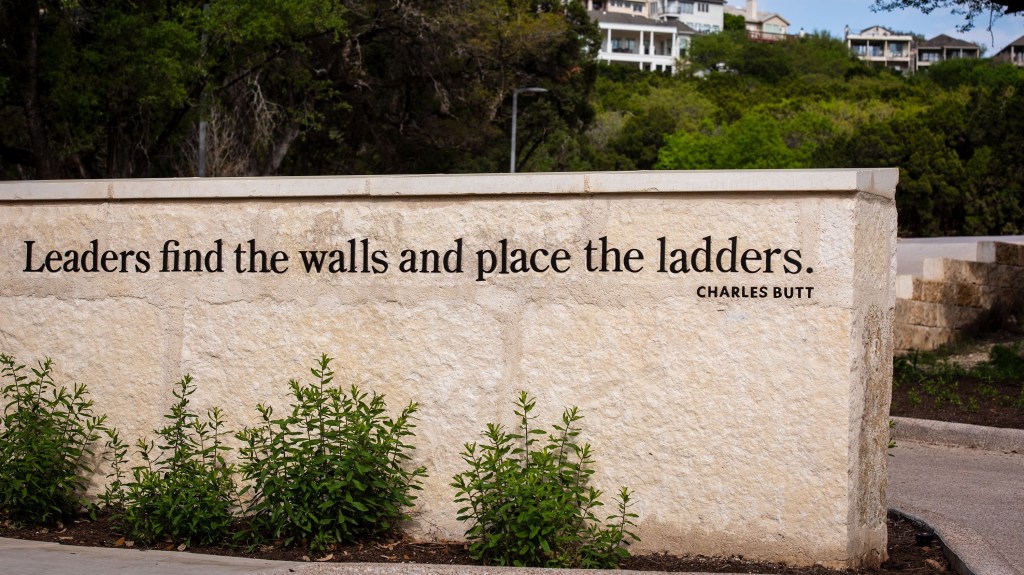
When thinking about leadership, certain individuals may stand out as inspirational or the opposite, hindering growth through their poor leadership. Good leaders motivate us to excel and try new things, while bad leaders can make us hesitant to share ideas or take risks. Many of us have experienced both types of leadership throughout our careers.
The definition of a leader in Merriam-Webster is: “a person who leads, such as a guide, conductor, a person who directs a military force or unit, a person who has commanding authority or influence.”
Merriam-Webster’s view of leadership is very perfunctory, missing what I believe to be the essence of true leadership: the act of service. Leaders with a servant’s heart take the time to genuinely connect with those they lead. To serve is to demonstrate love and kindness, recognizing that it is better to give than to receive. Such leaders reflect their vision for the organization by prioritizing others, putting customers first, and valuing the mission of the business and the growth of their teams above self-interest and titles.
We see five key differences between the traditional model of leadership and one that embraces servitude.
1. Power Dynamics
- Traditional Leadership: Focuses on a clear hierarchy with leaders in control.
- Servant Leadership: Shares power and prioritizes the needs of others for team development.
2. Goal Orientation
- Traditional Leadership: Leaders set goals to benefit the organization, possibly neglecting team development.
- Servant Leadership: Goals are set together, aiming for team and community benefits as well as organizational success.
3. Decision-Making Approach
- Traditional Leadership: Leaders make centralized decisions with little input from others.
- Servant Leadership: Decisions are made with team input, valuing diverse opinions for the group’s benefit.
4. Approach to Service
- Traditional Leadership: Service aims to fulfill the leader’s vision and goals.
- Servant Leadership: Leaders serve the team’s needs first, leading to a more committed workforce.
5. Development and Empowerment
- Traditional Leadership: Employee development is tied to organizational goals with limited empowerment.
- Servant Leadership: Focuses on individual growth and empowers team members to lead in their expertise areas.
Servant leaders strive to create and nurture a spirit of servitude among their teammates and clients. They are committed to spending time with their teams to remove obstacles and encourage collective successes over individual achievements. By encouraging teamwork, servant leaders help remove barriers and focus on group success rather than individual wins. They believe in working together, especially when facing challenges, and refrain from blaming others when things go wrong. Instead, they learn from and coach organizations through failures. Great leaders have the ability to motivate organizations to “fail forward” onto the next great achievement.
These leaders create a space where everyone can share ideas, valuing different viewpoints and involving everyone in the decision-making process. They emphasize that working as a team is better than relying on individual skills alone and motivate their employees by showing them how their work benefits the company and its customers. They also ensure everyone understands the organization’s decision-making processes. Servant leaders understand that it is teams, not individuals, who safely climb mountains.
When a leader is merely a symbolic head, people may obey but won’t be truly motivated or supportive of the leader’s vision, leading to a basic boss-employee dynamic. In contrast, servant leadership promotes a culture of mutual respect and shared growth, which not only improves organizational performance but also leads to a more dedicated and satisfied workforce.
The world and our offices would be much better places if we embraced a servant leadership mindset. Whom are you going to serve today?


 Down the Rabbit Hole...
Leave a comment